
In modern software design, we are obsessed with “frictionless” experiences. We worship at the altar of Google Docs, Notion, and Figma, where every error is a temporary lapse, easily erased by the grace of Ctrl+Z. In the SaaS world, efficiency is king, and the “Undo” button is the safety net that allows us to move fast and break things.
But at Vecmocon, we build software for a world where “breaking things” isn’t an option.
When you are designing the interface for Vec-TR.ai, our vehicle intelligence platform, you aren’t just managing data; you are managing kinetic energy. When an engineer prepares a Firmware Over-The-Air (FOTA) update for a fleet of 10,000 electric scooters, a single accidental click doesn’t just delete a paragraph—it can “brick” a fleet, strand riders in traffic, or disrupt a Battery Management System (BMS) mid-calculation.
In the world of Software-Defined Vehicles (SDV), the “Undo” privilege doesn’t exist. Here is how we design for the “No Ctrl+Z” reality.
The Psychology of “FOTA Anxiety”
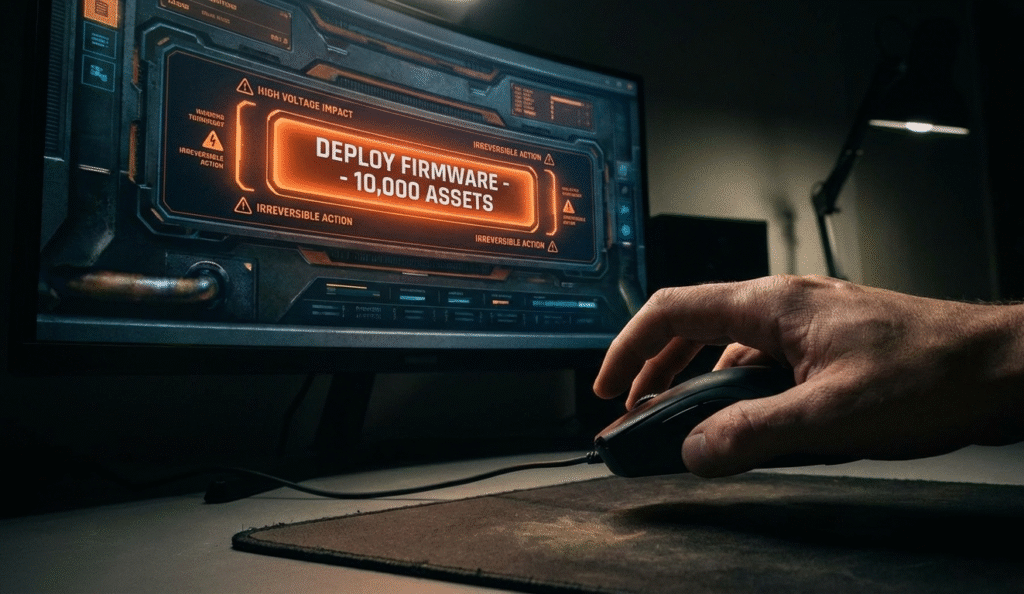
Before we wrote a single line of CSS for our FOTA module, we sat with OEM engineers. We observed a phenomenon I call “The Hover Hesitation.” It’s that cold moment of anxiety where an engineer’s mouse hovers over the ‘Deploy’ button. They’ve checked the code, they’ve run the simulations, but the weight of deploying firmware to thousands of high-voltage assets is immense. In typical UX design, our job is to remove that hesitation.
We did the opposite.
We realized that for mission-critical interfaces, delight is secondary to confidence. We stopped trying to make the process “fast” and started making it “deliberate.” We introduced Intentional Friction—designing obstacles that force the human brain to switch from “autopilot” to “active engagement.”
The Vec-TR Solution: Two-Step Cognitive Verification
To manage this “No Ctrl+Z” environment, we restructured the FOTA workflow into three distinct, high-friction zones: File Management, Command Creation, and Command Tracking.
1. File Management: The Integrity Gate
In a standard app, uploading a file is a background task. In Vec-TR, it is a formal declaration. The system doesn’t just “take” the file; it validates it against the hardware architecture. If you try to upload a firmware binary meant for a Proton-series BMS into an Electron-series VIM (Vehicle Intelligence Module), the UI doesn’t just show an error—it stops the journey. We force a manual verification of checksums, ensuring the “Source of Truth” is untainted before it ever reaches the “Send” stage.
2. Command Creation: Moving from “Click” to “Commit”
This is where we implemented Two-Step Cognitive Verification. Instead of a single “Update” button, we broke the action into two distinct psychological phases:
- The Intent: Selecting the fleet and the firmware.
- The Commitment: A secondary confirmation screen that summarises the impact: “You are about to update 4,500 assets. Estimated downtime: 12 minutes. Continue?”
We often require the user to type a specific confirmation word or perform a non-standard gesture. This breaks the muscle memory of clicking “OK” and forces the prefrontal cortex to engage.
3. Command Tracking: The “Point of No Return”
Once the command is live, the UI shifts from a “Management” tool to a “Monitoring” tool. We provide real-time telemetry on the update’s progress across the fleet.
Safety Nets in a Hard-Wired World
Since we can’t Ctrl+Z, we built “Escape Hatches” instead. These are not “Undo” buttons, but systemic safeguards:
- Asset Validation: The VIM (Vehicle Intelligence Module) checks the vehicle’s state before accepting the update. If the scooter is moving or the SOC (State of Charge) is below 20%, the update is rejected at the edge.
- The Abort & Retry Logic: While you can’t “undo” a partial flash, you can halt a rollout. If the first 50 vehicles show a spike in CAN bus errors, our system allows for an immediate “Global Abort” to save the remaining 9,950 assets.
- Scheduled Triggers: We implement scheduled triggers, giving teams a “cooldown” window between the setup and the execution.
Designing for Confidence, Not Just Delight
As designers in the deep-tech space, we have a different North Star. We aren’t trying to keep users on our platform for hours; we want them to spend as little time as possible in our FOTA module, but feel 100% certain while they are there.
At Vecmocon, we solve problems that go far beyond “changing button colors.” We are designing the digital-to-analogue interface that powers the future of mobility. We don’t design for the ease of a keystroke; we design for the safety of the rider and the integrity of the machine.
In a world without Ctrl+Z, friction is the ultimate safety feature.